Understanding ADHD: Five Common Challenges and Practical Strategies to Manage Them

Attention Deficit Hyperactivity Disorder, commonly known as ADHD, is a neurodevelopmental condition that affects millions of people around the world. It is not a sign of low intelligence, laziness, or a lack of effort. Instead, ADHD is simply down to how the brain develops and processes information, particularly regarding executive functions like focus, impulse control, and organisation.
People with ADHD often experience the world a little differently. While it can bring distinct strengths such as high creativity, enthusiasm, and an ability to think outside the box, it also presents everyday obstacles. Whether diagnosed during childhood or later in adult life, understanding how ADHD works is the first step towards managing its demands.
In this guide, we will explore what ADHD is, break down five of the most common difficulties experienced by people with ADHD, and share two practical strategies to help manage each one effectively.
What Exactly is ADHD?
At its core, ADHD affects the executive function system of the brain. You can think of executive function as the brain’s central control system. It handles planning, focusing, remembering instructions, and juggling multiple tasks.
In a neurotypical brain, chemical messengers like dopamine help carry messages smoothly across this control network. In an ADHD brain, these chemical messengers do not work in quite the same way. This makes it harder to regulate attention, manage time, and filter out distractions.
ADHD is generally grouped into three main types:
Inattentive: Difficulty staying focused, following detailed instructions, and staying organised.
Hyperactive-Impulsive: High physical energy, restlessness, and acting or speaking before thinking things through.
Combined: A mixture of both inattentive and hyperactive-impulsive symptoms.
Living with ADHD means facing specific, regular hurdles. However, with the right techniques, tools, and support systems in place, these challenges can become easier to navigate.
Difficulty 1: Executive Dysfunction and Task Initiation
Starting a task, especially one that feels boring, overwhelming, or complex, can feel like trying to push a heavy boulder uphill. This is often referred to as a failure of "task initiation." It is not that a person with ADHD does not want to do the work; rather, the brain struggles to generate the initial burst of motivation required to begin.
When executive dysfunction kicks in, simple actions like opening a computer document, clearing a desk, or starting a laundry load can lead to feeling completely paralyzed.
Strategy A: The "5-Minute Rule"
The 5-Minute Rule is a simple strategy designed to lower the mental barrier to getting started. Tell yourself that you only have to work on the task for exactly five minutes. Once the five minutes are up, you give yourself full permission to stop if you want to.
Most of the effort required for someone with ADHD goes into breaking the initial inertia. Once you cross that starting line and engage with the material, momentum often takes over, making it much easier to keep going.
Strategy B: Micro-Stepping (Chunking)
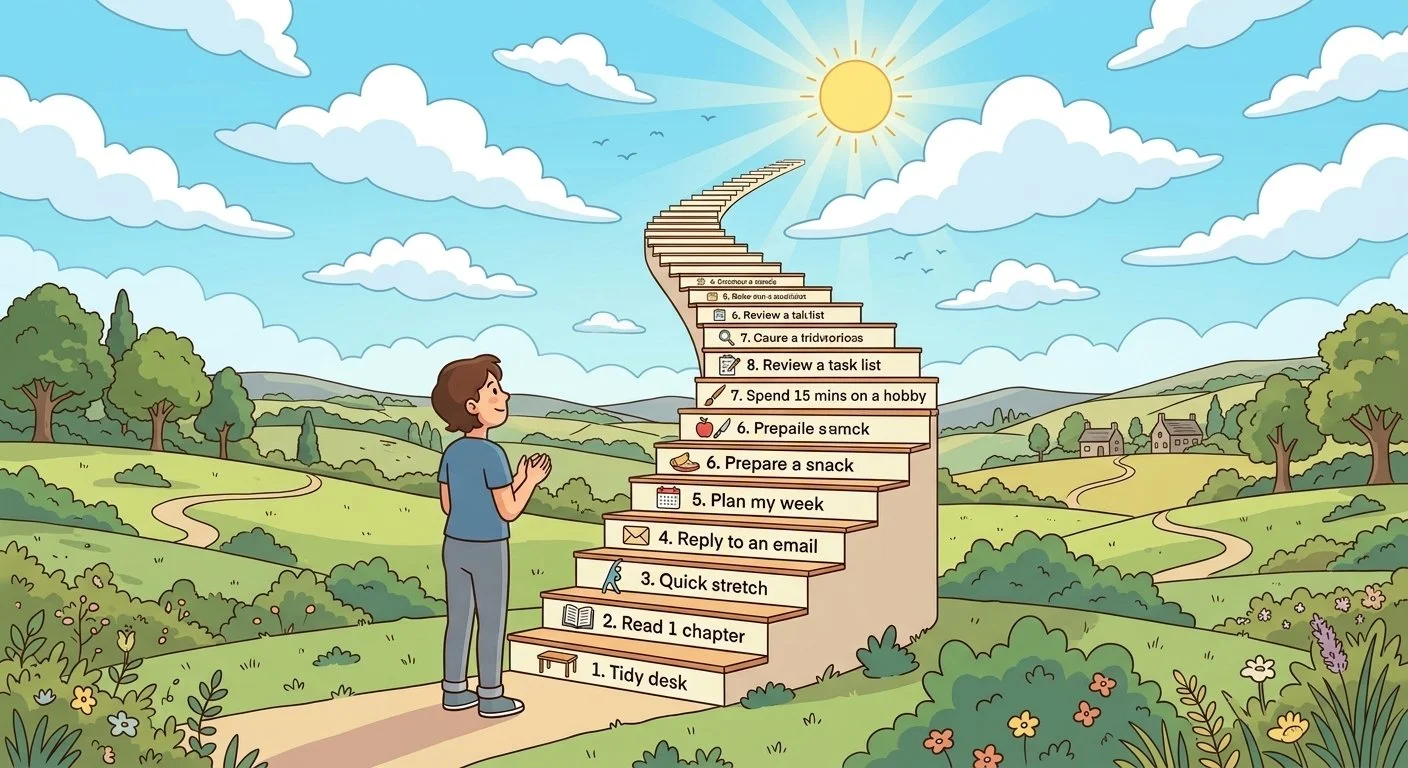
Large projects often feel intimidating because the brain cannot process all the steps at once. Micro-stepping means breaking a large job down into the smallest possible actions.
For instance, instead of writing "clean the bedroom" on a to-do list, break it down into tiny, actionable steps:
Pick up three dirty socks from the floor.
Put the books on the shelf.
Make the bed.
By focusing on one tiny action at a time, you remove the feeling of overwhelm and give your brain a quick win with every completed step.
Difficulty 2: Time Blindness
Time blindness is a term used to describe the difficulty people with ADHD have when estimating, sensing, or tracking the passage of time. For many, time exists in only two zones: "Now" and "Not Now."
This can lead to consistently running late, missing key deadlines, or misjudging how long routine activities actually take. It is not an intentional lack of respect for other people's time, but rather a difference in internal time perception.
Strategy A: Use Visual Timers
Standard digital or analogue clocks require your brain to calculate how much time has passed mentally. Visual timers, on the other hand, show time as a shrinking disc of colour.
As time ticks away, the coloured section disappears. This converts an abstract concept like "twenty minutes" into a clear, physical picture. Placing a visual timer directly on your desk provides a continuous, subtle cue that keeps you grounded in the present moment.

Strategy B: Work Backwards from Deadlines
When planning an event or appointment, start with the final arrival time and calculate backwards to work out when to begin preparing.
If you need to leave the house at 8:30 AM:
Subtract 15 minutes to gather your keys, coat, and bag (8:15 AM).
Subtract 30 minutes to get dressed and brush your teeth (7:45 AM).
Subtract 20 minutes for breakfast (7:25 AM).
Subtract 10 minutes to wake up fully (7:15 AM).
Setting alarms for these individual transition points prevents the sudden surprise of running out of time.
Difficulty 3: Working Memory Deficits
Working memory is like a mental sticky note. It holds small bits of information in your mind temporarily while you use them. People with ADHD frequently have a smaller working memory capacity.
This explains why someone might walk into a room and instantly forget why they are there, lose their train of thought midway through a sentence, or drop items like keys and phones without realizing where they put them down.
"Working memory acts like the scratchpad of the mind. When it fills up quickly, crucial details can slip away before we get the chance to use them."
Strategy A: Externalise Everything (The "External Brain")
Do not rely on your mind to store daily lists, reminders, or random ideas. Get into the habit of writing everything down immediately in one centralized place.
This could be a physical notebook that you carry everywhere or a reliable notes app on your phone. By taking information out of your head and storing it externally, you free up processing power in your brain and protect important details from disappearing.
Strategy B: Create Launchpads for Daily Items
To stop misplacing essential belongings, establish dedicated drop zones or "launchpads" near your front door or workspace.
Assign one specific bowl, hook, or tray for items like:
House keys and car keys
Wallets and purses
ID badges and lanyards
Daily prescription glasses
Make it a strict habit that these items go into their designated home the exact second you enter the room. If an item always lives in the exact same spot, you do not need to rely on working memory to locate it later.

Difficulty 4: Emotional Dysregulation and Rejection Sensitivity
While ADHD is mostly discussed in terms of focus and energy, it also plays a significant role in how emotions are processed. Emotional dysregulation means that feelings like frustration, sadness, excitement, or anger can hit much harder and feel far more intense than usual.
Many individuals with ADHD also experience Rejection Sensitive Dysphoria (RSD). This involves an intense emotional pain triggered by the perception that they have failed, disappointed someone, or been rejected, even when no rejection was actually intended.
Strategy A: The "Pause and Name" Technique
When a wave of intense emotion hits, try to introduce a momentary break between the feeling and your response.
Take three deep, slow breaths to steady your nervous system.
Silently label the feeling: "I am feeling overwhelmed right now" or "This feels like rejection."
Naming the emotional state helps move brain activity away from the emotional centre and back towards the logical processing area, giving you space to evaluate the situation calmly.
Strategy B: Build a "Fact-Checking" Habit
Because RSD can cause minor interactions to feel like severe criticism, practice fact-checking your internal narrative before reacting.
Ask yourself these quick questions:
What are the objective facts of this situation?
Is there another reasonable explanation for this person's tone or reaction?
Am I assuming the absolute worst-case scenario without solid proof?
Separating actual facts from emotional assumptions helps prevent unnecessary distress and keeps small miscommunications from spiralling into big arguments.
Difficulty 5: Hyperfocus and Managing Transitions
While struggling to focus is a well-known aspect of ADHD, the opposite state, known as hyperfocus, is just as common. Hyperfocus occurs when an individual becomes so intensely absorbed in an engaging topic or activity that they lose track of everything else around them.
While hyperfocus can boost productivity during creative projects or hobbies, it can also lead to neglecting basic physical needs, ignoring important responsibilities, and struggling to switch tasks smoothly.
Strategy A: Set "Auditory and Physical" Alarms
A simple phone alarm is often not enough to break deep hyperfocus because it is too easy to turn off without thinking. Instead, use alarms that require physical movement to stop.
Place an alarm clock across the room so you are forced to stand up, walk over, and turn it off. Combining sound with physical movement pulls your mind out of the hyperfocus loop and gives you a natural moment to transition to your next task.
Strategy B: Plan Transition Routines
Moving straight from an enjoyable, high-dopamine task to a boring or routine one can feel physically uncomfortable. Creating gentle transition routines helps bridge this gap.
Before switching tasks:
Step away from your desk and stretch for two minutes.
Drink a glass of fresh water.
Listen to one fast, upbeat song to keep your energy high.
These quick buffer activities make task switches feel less abrasive to an ADHD brain.
Final Thoughts
Living with ADHD comes with unique challenges, from managing time and holding onto daily details to keeping intense emotions in check. However, having ADHD does not mean you cannot reach your personal goals or build a structured, fulfilling routine.
By understanding how your brain works and introducing practical strategies tailored to your needs, like visual timers, micro-stepping, drop zones, and gentle transition routines, you can turn everyday obstacles into manageable steps. Remember, managing ADHD is not about changing who you are; it is simply about setting up the right support systems so you can thrive.
